
The World's Smallest Volcano
The World Cup Series Part 1: Mexico

“The only snow I’ve seen person,” my friend said as we drove through his hometown of Puebla, Mexico “was the ash from the volcanic eruption a few years ago.”
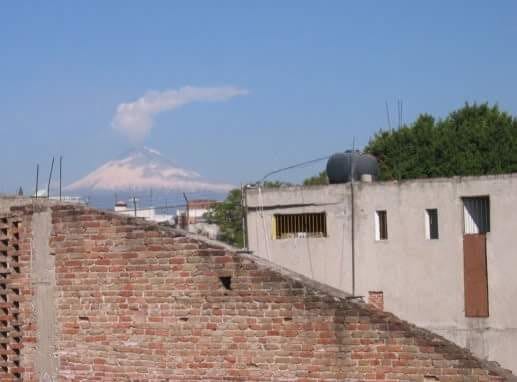
In the distance lay a mountain whose snow capped peak was the impetus for my question. It and the other routinely visible mountains reminded me not only of the natural beauty that surrounded me, but of the dangerous and capriciousness of nature. All 3 of the visible mountains—La Malinche closest and the one we were looking at; Iztaccihuatl, the reclining woman under her blanket of snow, and her lover, the fiery Popocatépetl—were volcanoes.1 In the distance to the east, invisible over the horizon, sat Mexico’s highest peak, the Pico de Orizaba.
For some, thinking of Mexico conjures the white sand beaches of the Riviera Maya, a dusty Sonoran desert vista covered in cactii, or the monumental Zócalo in the capital. For others, maybe huipil-wearing Indigenous women in Chiapas come to mind or the grand beauty of the pyramids in Teotihuacan. For me, beyond the specifics of my experiences in Puebla, it is the sweeping mountain views from my rooftop in the center of the city.
There are no trans-mountain military campaigns like Hannibal crossing the Alps or the terrible fate of the Donner Party to burnish its legend in the popular imagination, but the altitude within the Valley of Mexico and its neighboring areas are surprising for some. The capital is, after all, some 2,000 feet higher than Denver, Colorado and squarely in the “Wow, the air is thinner here, isn’t it?” geographical category. Although all sorts of local ecoregions exist there, the dominant feature are the surrounding mountains. Even within the city limits, the outrageous heights of Ajusco volcano soar above the urban landscape, reaching nearly 13,000 feet.
In Puebla, some 80 miles to the southeast of Mexico City and 300 or so feet lower in elevation, the air remained noticably thinner than my parents’ home near sea level in New York. I played soccer and went jogging in Puebla a couple of times and found myself out of breath in ways that reminded me of earlier trips to Guatemala’s Cuchumatanes, where I climbed La Torre and played soccer, and just casually walking around Cusco, Peru if noticeably less difficult than a hike in the Peruvian Andes turned out to be.2
Puebla is a hybrid of sorts, caught between its status as a major city under Spanish colonial rule, with its ceramic work—talavera, azulejo—and religiosity, and its modern growth as a manufacturing hub and transition from an agicultural center.3 As with any city, there are complex social and political realities, but the main thing that Puebla is known for outside of its own borders is the Battle of Puebla, which spawned the yearly Cinco de Mayo celebrations to commemorate the defense of the forts above the city against a French imperial force.4
Besides learning how to cope with the altitude and the pollution or finding my way through some of the cultural challenges, there was learning how to pronounce the names of the volcanoes. It wasn’t just a question of being able to say their names, but also of exactly when we would all be obliterated by the earth exploding and burying us in either boiling lava or toxic ash. Or both.
That snow my friend mentioned, the volcanic ash spewed from Popo, as it’s known, has been an increasing presence in the city since volcanic activity reemerged in 2000 with a major eruption. My geological knowledge is low, but towering plumes of smoke count as an eruption to me and since 2004 there have been fairly continuous eruptions.
My questions about snow, about ash, about when we were all going to die in a hail of large boulders the size of small boulders prompted a discussion about local volcanoes.
“You know there’s one in Puebla, right?”
And indeed, there is. Or, well, sort of. It’s called Cuexcomate and it is the world’s smallest volcano. It’s a dormant — and minisicule — cone some 40 feet high. You can climb down into it via the spiral staircase that has been installed. When I was there, it was a bit eeirie, with little puddles in the corner and a fair bit of graffitti along the walls. It has since been cleaned up, with a new floor installed along with a fence between siteseers and a deeper cavern area. There are chairs in a picture from 2017.
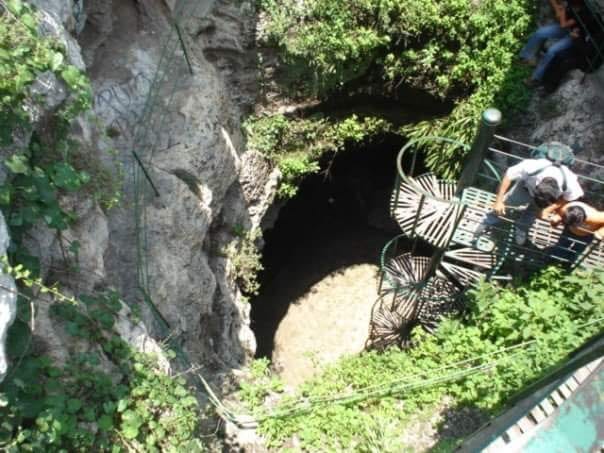
How does such a volcano exist, I wondered, imagining some sort of spout hole for a lava flow, but not explosive debris flinging everywhere. Maybe an earthquake brought it closer to street level sometime in antiquity or in a different epoch? Maybe the area is just built up around it so that it looks like its prominence is low? I imagined a reawakening of this minisicule volcano, a shudder of the earth, and a neighborhood drowns in red hot liquid. Pompei, but somehow worse.
The dirty little secret of Cuexcomate is that it is not actually an extinct volcano: it is a dormant geyser. Knowing that makes it a little less dangerous, although just to be clear to the gods, I also do not want to get caught in scalding water if it ever comes down to that. This is not an either/or. Death by earthly expellents is something I want to avoid, regardless of which particular form of geothermal material is doing the deed.
“It’s time for some food,” my friend says, our conversation about snow-that-is-ash done. “We’ll get some tacos and maybe you can experience that death by lava anyway, gringo.”
Now that would be a death worth dying.
Queztaltenango, Guatemala, which I have discussed in prior pieces throughout my blogging career, is 300 feet higher than Mexico City, but substantially less polluted and thus easier to run around in; outlying areas within the department varied in altitude enough that I couldn’t keep track.
Cusco, Peru, on the other hand, is over 11,000 feet up and is listed as the 9th highest city in the world. I found it difficult to walk around the first day just based on the lack of oxygen. Were Peru in this World Cup, I certainly would be including a section about hiking up Huayna Picchu, but alas.
For example, the outlying city of Atlixco is known mainly for its flowers, although it also has manufacturing as well.
It’s not Mexican Independence Day!